


Dhesarme Holds the 3rd Edition of the Introduction to Humanitarian Disarmament Course at UNILA

Held between May and June of this year, the Introduction to Humanitarian Disarmament Course is a project that seeks to create a learning space on crucial topics for understanding the principles governing International Humanitarian Law and Humanitarian Disarmament, democratizing access to these discussions and emphasizing their relevance to the construction of societies grounded in a Culture of Peace.
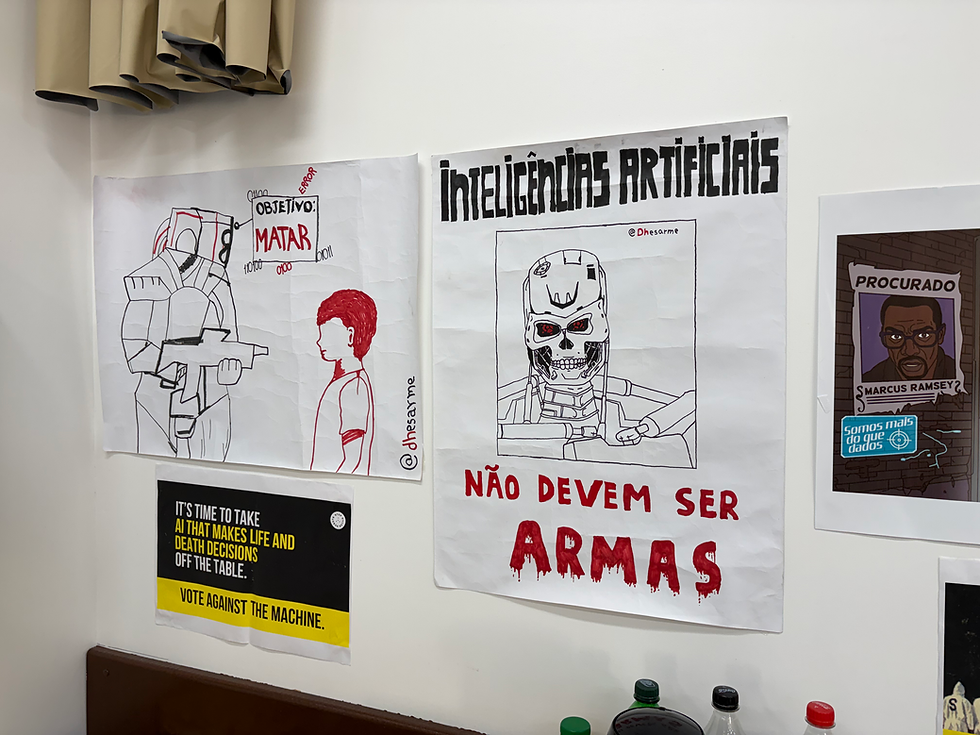
Held in person at the Integração Campus of the University of Latin American Integration (UNILA), in Foz do Iguaçu, the third edition of the course was divided into five sessions: Introduction to International Humanitarian Law; Humanitarian Disarmament and Anti-Personnel Landmines; Cluster Munitions; International Arms Trade; Nuclear Weapons; and Autonomous Weapons. Throughout each module, Dhesarme had the honor of welcoming specialists in each of the topics addressed, including Professors Gustavo Oliveira Vieira (UNILA), Cristian Wittmann (SEHLAC), and Vera Liquidato (USP); activists Alejandra Uscategui Montaña (Campaña Colombiana Contra Minas), Maria Pía Devoto (APP, SEHLAC), Natália Pollachi and Bruno Langeani (Instituto Sou da Paz), Leonardo Gómez Berniga (UNIDA), and Gisela Luján Andrade (Perú por el Desarme, SEHLAC); lawyer Rafael Euclides Seidel Batista; journalist João Paulo Charleaux (Portal UOL); and activist and Anti-Personnel Landmine survivor Luis Silvestre Wamusse (DONAKATI).
Throughout these five days, students and members of the academic community had the opportunity to deepen their knowledge of the humanitarian impacts of weapons, particularly those that are inherently indiscriminate, as well as of the international efforts aimed at their regulation and prohibition. In this regard, the course proposed a reflection on the main contemporary challenges facing International Humanitarian Law (IHL) and humanitarian disarmament, with particular attention to emerging issues such as Autonomous Weapons Systems, digitalization, and artificial intelligence, while considering factors such as gender and race in understanding their potential impacts.

Furthermore, the presentation of updated reports on the humanitarian consequences of weapons such as Anti-Personnel Landmines and Cluster Munitions, together with data on, for example, the flow of the conventional arms trade, made it possible to recognize the importance of International Humanitarian Law and advocacy for the regulation and prohibition of weapons in guaranteeing Human Rights and protecting civilian communities and the environment. Moreover, during modules such as Nuclear Weapons, participants were encouraged not only to understand these weapons through the lens of their conventional impacts, but also to reflect on these issues from a Latin American perspective and on the regional instruments that exist for the regulation of such weapons.
By inviting not only technical experts but also survivors such as Luis Wamusse, the initiative seeks to raise awareness and humanize the impacts of these weapons for an audience that is often unfamiliar with such discussions. Finally, the project reinforces Dhesarme's commitment to peace education, raising awareness of the impacts of weapons on civilian populations and the environment, and fostering new generations of researchers, activists, and professionals committed to promoting human security and human dignity.
23/06/2026 BRT


Comments